
Key Takeaways
- Can a hernia go away on its own? In adults, no. The weak spot in the muscle wall stays and usually grows slowly.
- The one common exception is an umbilical hernia in babies, which often closes by itself in early childhood.
- Belts, exercises and home remedies may ease discomfort, but they cannot close a hernia.
- Some small, painless hernias can be safely watched for a while, but only under a doctor’s advice.
- A hernia that becomes hard, very painful or cannot be pushed back is a medical emergency.
Introduction
You notice a small bulge in your groin or near your belly button. It doesn’t hurt much and seems to disappear when you lie down. It is natural to hope it will simply go away.
It is one of the most common questions surgeons hear: can a hernia go away on its own? The honest answer for adults is no. But that does not always mean you need surgery tomorrow. This guide explains why hernias don’t heal by themselves, when it may be safe to wait, and the warning signs that mean you should not.
In This Article
- What Is a Hernia?
- Can a Hernia Go Away on Its Own? Why the Answer Is No
- Do Hernia Belts, Exercises or Home Remedies Work?
- Is It Safe to Wait?
- What Happens If a Hernia Is Left Untreated?
- Emergency Warning Signs
- How to Keep a Hernia From Getting Worse Until Treatment
- Common Hernia Myths and the Facts
- How Hernias Are Treated
- Frequently Asked Questions
- Hernia Treatment at Medfine Hospitals
What Is a Hernia?
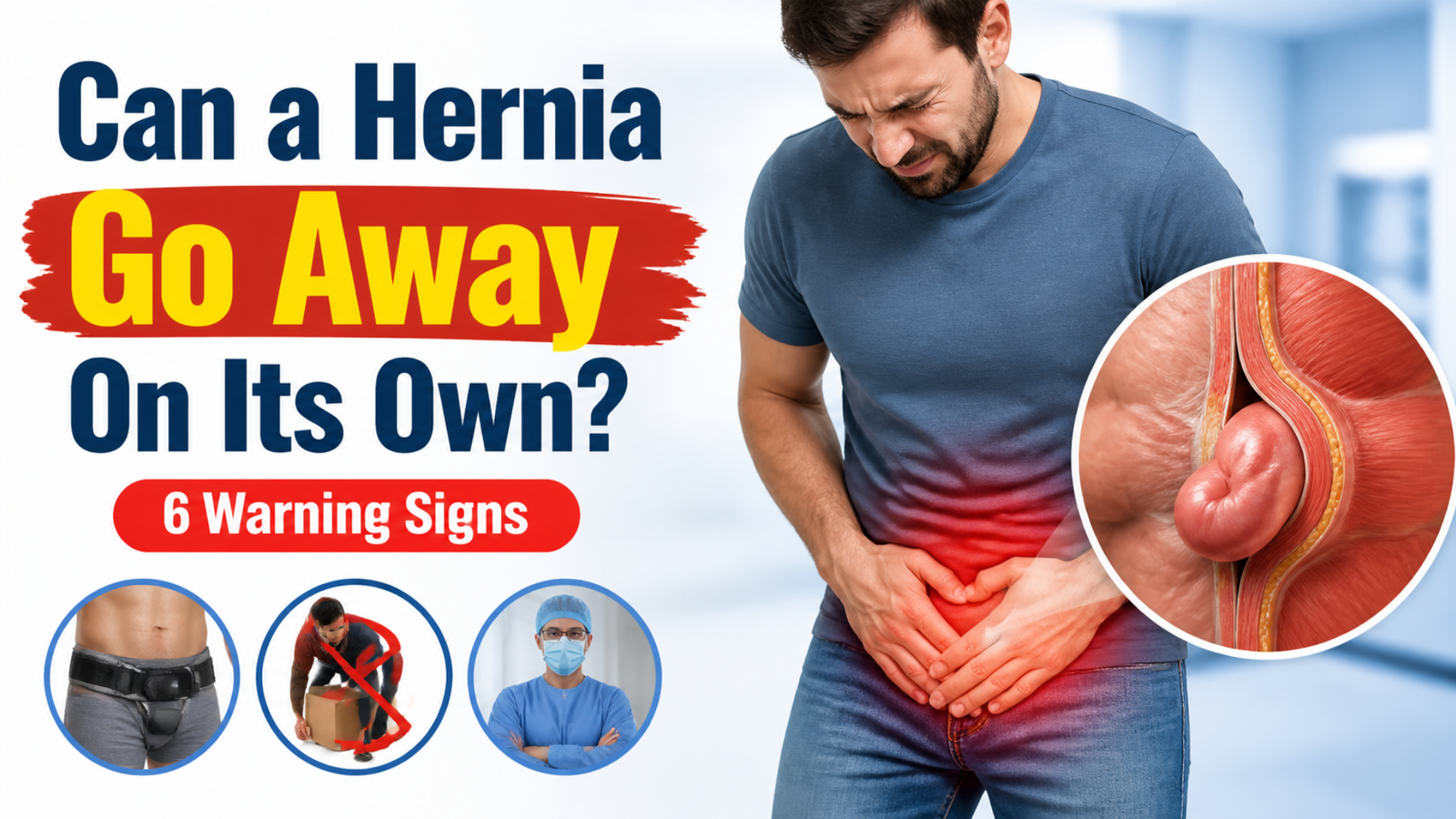
A hernia happens when part of an organ, usually the intestine or fatty tissue, pushes through a weak spot in the muscle wall of the abdomen. The most common types are:
- Inguinal hernia: in the groin, much more common in men
- Umbilical hernia: at or near the belly button
- Femoral hernia: in the upper thigh near the groin, more common in women
- Incisional hernia: through the scar of an earlier abdominal surgery
See the difference between inguinal and umbilical hernia for more detail.
The NHS overview of hernias is another useful source of general information.
Can a Hernia Go Away on Its Own? Why the Answer Is No
A hernia is a physical gap in the muscle wall, not an infection or swelling that the body can repair. Muscle does not grow back to close such an opening in adults.
Every time you cough, lift, strain on the toilet or stand for long hours, pressure inside your abdomen pushes against the gap. Over months or years, this tends to make the opening and the bulge bigger.
The bulge may seem to “disappear” when you lie down because the tissue slips back inside. The hernia is still there; it has only moved back temporarily.
The exception: babies. Umbilical hernias are common in infants and often close on their own within the first few years of life. Adult hernias, and inguinal hernias at any age, do not close this way.
Do Hernia Belts, Exercises or Home Remedies Work?
| Option | What it can do | What it cannot do |
|---|---|---|
| Hernia belt or truss | Holds the bulge in and may reduce discomfort for a time | Close the gap; long-term use can irritate the skin |
| Core exercises | Improve general strength and posture | Repair the hole; heavy or straining exercises can make it worse |
| Weight loss | Reduces pressure on the abdomen | Make an existing hernia disappear |
| Ayurvedic or herbal remedies | No proven benefit for a hernia | Close the defect in the muscle wall |
These measures can help you stay comfortable while you plan treatment, but surgery is the only way to repair a hernia.
Is It Safe to Wait?
Sometimes. For a small, painless inguinal hernia that does not affect daily life, a surgeon may suggest “watchful waiting”: regular check-ups instead of immediate surgery. However:
- Many people who choose to wait eventually need surgery as the hernia grows or starts to hurt.
- Femoral hernias are usually repaired early, because they are more likely to trap the intestine.
- Surgery done at a planned time is simpler, safer and has a faster recovery than emergency surgery.
Waiting should always be a decision made with a doctor, not a way of avoiding the problem.
What Happens If a Hernia Is Left Untreated?
- The bulge grows and becomes more uncomfortable, especially when standing, lifting or coughing.
- Incarceration: the tissue gets stuck outside the muscle wall and can no longer be pushed back in.
- Strangulation: the trapped tissue loses its blood supply. This is a surgical emergency that can damage the intestine within hours.
Emergency Warning Signs
Go to a hospital immediately if you have a hernia and notice:
- Sudden, severe pain at the hernia site
- A bulge that becomes hard, tender, or cannot be pushed back in
- The bulge turning red, purple or dark
- Nausea or vomiting
- Being unable to pass gas or stool
- Fever with hernia pain
How to Keep a Hernia From Getting Worse Until Treatment
- Avoid lifting heavy objects; bend your knees if you must lift
- Prevent constipation with fibre, water and regular meals
- Get a long-standing cough treated
- Maintain a healthy weight and stop smoking
- Do not try to force a painful bulge back in
Common Hernia Myths and the Facts
- Myth: A hernia will heal with rest. Fact: Rest may ease pain, but the gap in the muscle stays.
- Myth: If it doesn’t hurt, it doesn’t need attention. Fact: Painless hernias can still grow or get trapped. A doctor should check every new bulge.
- Myth: A hernia belt is a cure. Fact: A belt only holds the bulge in. It does not repair the muscle wall.
- Myth: Only men get hernias. Fact: Women get them too, and femoral hernias are more common in women.
- Myth: Hernia surgery means a long hospital stay. Fact: Most planned repairs are day-care or overnight procedures, and many people return to desk work within 1 to 2 weeks.
How Hernias Are Treated
Hernia repair is one of the most common planned surgeries. The surgeon pushes the tissue back into place and strengthens the weak area, usually with a soft mesh.
- Laparoscopic (keyhole) repair: small cuts, less pain, and a return to light work in about 1 to 2 weeks for many people.
- Open repair: one small cut over the hernia; still a quick, routine procedure.
Most patients go home the same day or the next day. Women may notice different symptoms; read hernia symptoms in women.
Frequently Asked Questions
Can a small hernia heal on its own?
No. Even a small hernia in an adult will not close by itself, but a small, painless one may be watched safely for a while with a doctor’s guidance.
Can a hernia go back in by itself?
A reducible hernia can slip back when you lie down. This does not mean it has healed; it will usually come out again.
How long can you live with a hernia?
Some people live with a small hernia for years, but the risk of it growing or getting trapped remains. Planned repair avoids emergency surgery later.
Will a hernia come back after surgery?
Recurrence is uncommon after a modern mesh repair, especially if you follow the recovery advice.
Hernia Treatment at Medfine Hospitals
At Medfine Hospitals in BTM Layout, Bengaluru, our general and laparoscopic surgeons treat inguinal, umbilical and other hernias with keyhole and open repair techniques. Learn more about hernia treatment in Bangalore.
Call 8431 159 357 or book a consultation to find out whether your hernia needs treatment now.