
Introduction
If you have been diagnosed with varicose veins, your doctor has likely recommended laser treatment. And like most patients, your first question is probably – “Is it really safe?”
It is a completely valid concern. The word “laser” can sound intimidating, and when it involves your veins, it is natural to want complete clarity before making a decision.
The short answer is – yes, laser treatment for varicose veins is not only safe but is considered the gold standard treatment worldwide, replacing traditional open surgery in most cases.
But you deserve more than just a short answer. In this detailed guide, the vascular surgery team at Medfine Hospital, BTM Layout, Bangalore explains exactly how the procedure works, why it is safer than surgery, what the real risks are, and what you can expect before and after treatment.
What Is Laser Treatment for Varicose Veins?
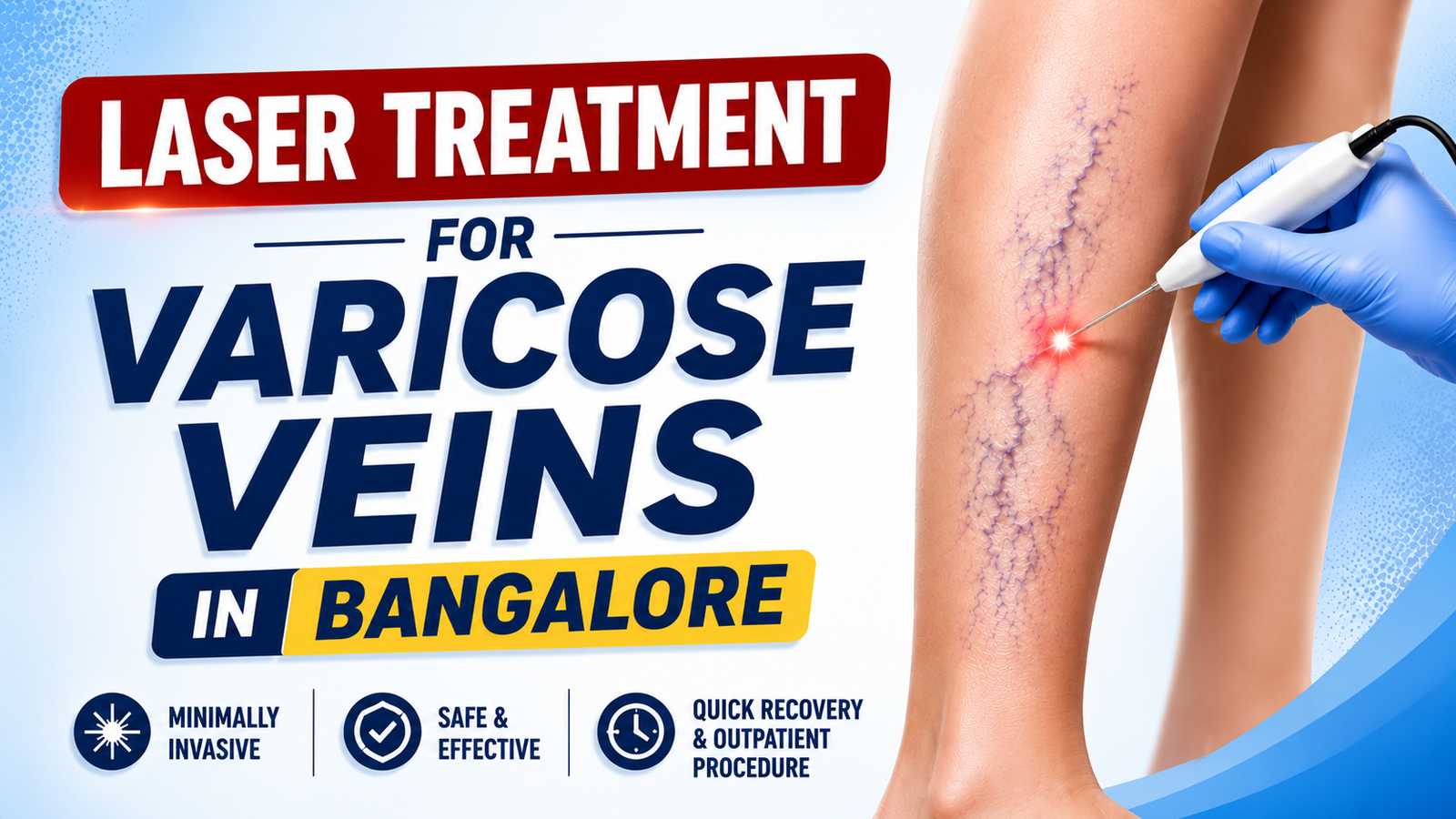
Laser treatment for varicose veins is medically known as EVLT – Endovenous Laser Treatment or Endovenous Laser Ablation (EVLA). It is a minimally invasive procedure that uses laser energy to close off and permanently seal the diseased vein from the inside – without any cuts or stitches.
Once the diseased vein is sealed, blood naturally reroutes itself through healthy veins nearby. The sealed vein gradually shrinks and is absorbed by the body over the following weeks.
This is fundamentally different from traditional varicose vein surgery (called stripping), where the vein was physically cut out through multiple incisions under general anesthesia – a procedure that required hospitalization, carried higher risks, and needed weeks of recovery.
How Is the Laser Procedure Performed? Step by Step
Understanding the procedure in detail is the best way to address safety concerns. Here is exactly what happens during EVLT at Medfine Hospital:
Step 1: Consultation and Doppler Ultrasound
Before the procedure, your vascular surgeon performs a venous Doppler ultrasound scan – a painless imaging test that maps your vein network, identifies which veins are diseased, and pinpoints the exact location of faulty valves. This scan guides the entire treatment plan.
Step 2: Local Anesthesia
On the day of the procedure, the treatment area is numbed using local anesthesia. You remain fully awake and comfortable throughout. There is no need for general anesthesia – which is one of the major safety advantages over traditional surgery.
Step 3: Insertion of the Laser Fiber
Using ultrasound guidance, the surgeon makes a tiny pinhole entry – smaller than a needle prick – and inserts a thin laser fiber into the diseased vein. No cutting or stitching is involved at any point.
Step 4: Tumescent Anaesthesia
A fluid called tumescent anesthesia is injected around the vein. This serves two purposes – it further numbs the area and protects the surrounding tissue from the laser heat.
Step 5: Laser Activation
The laser is activated and slowly withdrawn through the vein. The laser energy heats the vein wall from the inside, causing it to collapse and seal permanently. The entire process takes 30 to 45 minutes per leg.
Step 6: Compression Bandaging
Immediately after the procedure, a compression bandage or stocking is applied to the leg to support healing and minimize bruising.
Step 7: Going Home
Within 1 to 2 hours of the procedure, you walk out of the hospital on your own. There is no overnight stay required. This is a true day-care procedure.
Is Laser Treatment for Varicose Veins Safe? The Evidence
The safety of EVLT is backed by decades of clinical research and millions of successful procedures performed worldwide. Here is what the evidence shows:
High success rate: EVLT has a clinical success rate of 95 to 98% in closing diseased veins permanently – comparable or superior to traditional surgery.
Lower complication rate: Compared to open surgery, laser treatment carries significantly lower risks of infection, nerve damage, scarring, and post-operative complications.
No general anesthesia required: Eliminating general anesthesia removes one of the biggest risk factors associated with any surgical procedure – especially for older patients or those with underlying health conditions.
USFDA approved: Endovenous laser treatment is approved by the US Food and Drug Administration (USFDA) and has been adopted as the standard of care in leading hospitals across the world.
Minimal blood loss: Unlike stripping surgery, EVLT involves no cutting of veins – meaning virtually zero blood loss during the procedure.
Laser Treatment vs Traditional Surgery - A Direct Comparison
Hospital Stay | Day care – same day discharge | 1–3 days admission |
Cuts and Stitches | None – pinhole entry only | Multiple incisions |
Pain During Procedure | None | Moderate to high |
Recovery Time | 2–3 days | 2–4 weeks |
Risk of Infection | Very low | Moderate |
Scarring | None | Possible |
Recurrence Rate | Very low | Higher |
Return to Work | Next day for desk jobs | 2–4 weeks |
Blood Loss | Negligible | Moderate |
The difference is clear. For the vast majority of varicose vein patients, laser treatment is not just safer – it is a superior procedure in every measurable way.
What Are the Real Risks of Laser Treatment?
No medical procedure is completely without risk, and it is important to be honest about this. The known risks of EVLT are:
Bruising: Mild bruising along the treated vein is common and resolves within 1 to 2 weeks.
Mild Tenderness: Some patients experience mild soreness or tightness along the treated vein for a few days after the procedure. This is normal and manageable with basic pain medication.
Skin Numbness: In rare cases, temporary numbness or tingling may occur near the treated area due to minor nerve irritation. This almost always resolves on its own within a few weeks.
Superficial Thrombophlebitis: In rare instances, a small blood clot may form in a superficial vein near the treated area, causing temporary redness and tenderness. This is managed easily with anti-inflammatory medication and compression.
Deep Vein Thrombosis (DVT): This is an extremely rare complication occurring in less than 1% of cases. Your surgeon minimizes this risk through precise ultrasound-guided technique and by prescribing blood thinners if needed post-procedure.
Thermal Skin Injury: In very rare cases, the laser heat may cause minor skin discoloration near the entry point. This is avoided by experienced surgeons using proper tumescent anesthesia technique.
It is important to note – most of these complications are rare, mild, and temporary. Serious complications are extremely uncommon when the procedure is performed by a trained vascular surgeon using proper technique and equipment.
Who Is a Good Candidate for Laser Treatment?
EVLT is suitable for the majority of varicose vein patients. You are likely a good candidate if you have:
- Visible varicose veins causing pain, swelling, or heaviness
- Great saphenous vein (GSV) or small saphenous vein (SSV) reflux confirmed on Doppler ultrasound
- Grade 2, 3, or 4 varicose veins
- Skin changes, eczema, or early ulcers due to varicose veins
- Failed to respond to conservative treatments like compression stockings
You may not be suitable for EVLT if you have:
- Active deep vein thrombosis
- Very small or superficial spider veins (these may require sclerotherapy instead)
- Severe peripheral artery disease
- Pregnancy (treatment is usually deferred until after delivery)
Your vascular surgeon will assess your Doppler ultrasound results and overall health to determine the best treatment plan for your specific condition.
What to Expect After Laser Treatment - Recovery Timeline
One of the biggest advantages of EVLT is how fast and smooth the recovery is compared to surgery.
Day 1 (Procedure Day):
You go home within 1 to 2 hours of the procedure. You will be asked to walk for 30 minutes immediately after treatment – walking actually helps the healing process. Wear your compression stocking as instructed.
Days 2 to 3:
Mild bruising and tenderness along the treated vein is normal. Most patients are comfortable with basic pain relief like paracetamol. You can resume light daily activities immediately.
Days 3 to 7:
Most patients return to desk jobs and light work within 2 to 3 days. Avoid heavy lifting, intense exercise, and long-haul flights for 1 to 2 weeks.
Week 2 onwards:
Bruising fades, tenderness resolves, and the treated vein gradually shrinks. Most patients see visible improvement within 4 to 6 weeks as the sealed vein is absorbed by the body.
Long-term:
With proper post-procedure care – regular walking, compression stockings, maintaining a healthy weight – the results of laser treatment are long-lasting with very low recurrence rates.
5 Reasons Patients in Bangalore Choose Medfine Hospital for Varicose Vein Laser Treatment
- Experienced Vascular Surgeons
Our vascular surgery team has performed hundreds of successful EVLT procedures across all grades of varicose veins. - USFDA-Approved Laser Technology
We use only the latest, internationally certified laser systems – ensuring maximum safety and precision. - Doppler Ultrasound-Guided Precision
Every procedure at Medfine is performed under real-time ultrasound guidance – the international standard for safe and accurate EVLT. - True Day-Care Facility
Walk in, get treated, walk out – all in the same day. No unnecessary hospitalization. - Transparent and Affordable Pricing
We believe in complete cost transparency. No hidden charges, no surprise bills. Our team will give you a complete cost breakdown before you make any decision.
Varicose Veins Treatment at Medfine Hospital, Bangalore
At Medfine Hospital, BTM Layout, Bangalore, we specialize in advanced laser treatment for varicose veins (EVLT – Endovenous Laser Treatment) – the gold standard in modern vascular surgery.
Why patients across Bangalore choose Medfine:
- Completely painless laser procedure
- Day-care surgery – go home the same day
- No cuts, no stitches, no open wounds
- Resume normal work within 2–3 days
- USFDA-approved laser technology
- Experienced vascular surgeons with hundreds of successful procedures
- Transparent pricing – no hidden costs
- Conveniently located in BTM Layout, South Bangalore
Frequently Asked Questions
Is laser treatment for varicose veins painful?
No. The procedure is performed under local anesthesia and is virtually painless. Most patients report feeling only mild pressure or warmth during the procedure – no sharp pain.
How long does the laser procedure take?
The procedure typically takes 30 to 45 minutes per leg. Including preparation and post-procedure monitoring, most patients spend 2 to 3 hours at the hospital total.
Will varicose veins come back after laser treatment?
EVLT has a very low recurrence rate compared to traditional surgery. However, new varicose veins can occasionally develop in other veins over time – particularly if risk factors like prolonged standing, obesity, or pregnancy are not managed. Regular follow-up and lifestyle measures minimize this risk.
Is laser treatment for varicose veins covered by insurance?
Many health insurance policies in India cover EVLT when it is medically necessary. We recommend checking with your insurance provider before your procedure. Our team can assist you with pre-authorization documentation.
What is the difference between EVLT and sclerotherapy?
EVLT uses laser energy to close larger diseased veins (typically the great saphenous vein). Sclerotherapy uses a chemical injection to treat smaller spider veins and minor varicosities. Both are minimally invasive but are used for different sizes and types of veins. Sometimes both are combined for comprehensive treatment.
Can both legs be treated in the same session?
Yes. In many cases, both legs can be treated in the same session, though your surgeon will assess this individually based on the extent of disease.
Conclusion
Laser treatment for varicose veins is not just safe – it is scientifically proven, internationally endorsed, and has transformed the way varicose veins are treated worldwide. With no cuts, no stitches, no general anesthesia, and recovery in just 2 to 3 days, EVLT offers everything that traditional surgery could not.
If you have been putting off treatment because of fear or uncertainty, we hope this guide has given you the clarity and confidence to take the next step.